The Future of P2P EV Charging
Connect EV drivers with private charging stations. Earn money by sharing your charger or find convenient, affordable charging anywhere.
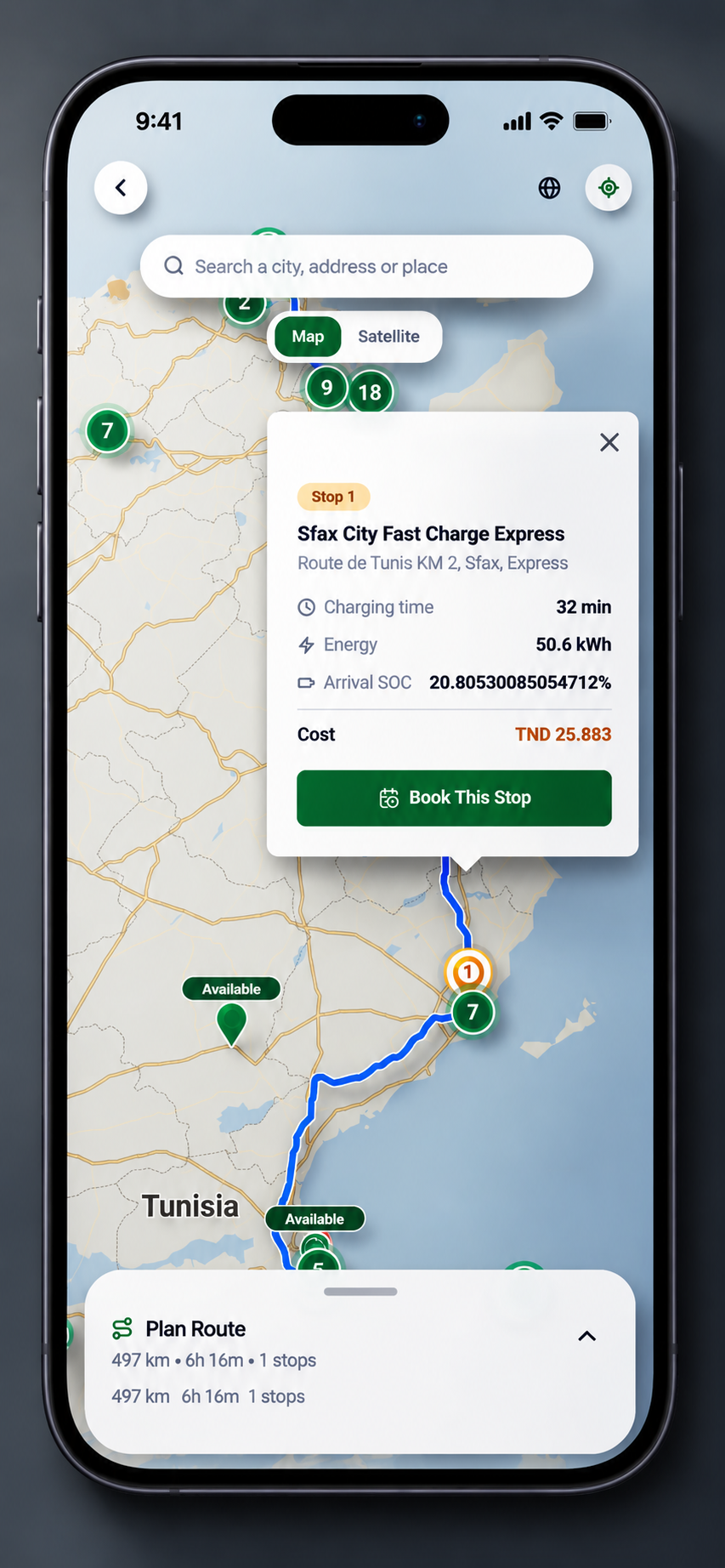
Lower Costs
Save up to 40% compared to public charging stations with competitive P2P rates.
More Locations
Access thousands of private charging points in residential areas and workplaces.
24/7 Availability
Find charging options anytime, anywhere with our extensive host network.
Peer to peer
Why Choose P2P Charging?
Peer-to-peer charging revolutionizes how we power electric vehicles, creating a decentralized network that benefits everyone.
Lower Costs
Save up to 40% compared to public charging stations with competitive P2P rates.
More Locations
Access thousands of private charging points in residential areas and workplaces.
24/7 Availability
Find charging options anytime, anywhere with our extensive host network.
Community Driven
Join a growing community of EV enthusiasts supporting sustainable transport.
Secure Payments
Safe, automated transactions with built-in insurance and dispute resolution.
Smart Matching
AI-powered system matches you with the perfect charging solution nearby.
Earn Money as a Charging Host
Turn your private charging station into a revenue stream. Share your charger when you're not using it.
Home Charging Sharing
List your home charger and earn passive income while you sleep or work.
Flexible Earnings
Set your own rates and availability. Earn TND200-800+ monthly on average.
Usage Analytics
Track your earnings, usage patterns, and optimize your charging schedule.
Host Protection
Comprehensive insurance coverage and 24/7 support for all host activities.

Perfect for EV Drivers
Find convenient, affordable charging options in your neighborhood and beyond.
Nearby Charging
Find available chargers within walking distance of your location.
Instant Booking
Reserve charging slots in advance or find immediate availability.
Easy Payments
Seamless in-app payments with transparent pricing and receipts.
Rated Hosts
Choose from verified hosts with community ratings and reviews.
How long will your car actually take to charge?
Pick your car and a charging point. The simulation runs on real manufacturer specs and models the battery charge curve, the taper, temperature and charging losses — not a kWh divided by kW.
Result
30.0 kWh into the battery at 11.0 kW average.
Billed energy
32.7kWh
Peak power
11.0kW
Vehicle limit
11.0kW AC
Range added
174km
Session cost
8.50TND
Cost per 100 km
4.89TND
0.260 TND/kWh all in · tranche 201-300 kWh/month: 218 millimes + 13% VAT + 14 millimes of levies · Plug-to-battery efficiency 92 %
What limits this session
The charging point is the limit — your car could accept more power.
Power over the session
Other vehicle (enter specs manually)The same session elsewhere
Specifications for 500 models from the Open EV Data catalogue. Results are a simulation: real sessions vary by ±10-15% with pack age, cable, grid voltage and station load.
Prices follow the STEG low-voltage tariff of 1 May 2022, plus VAT and the levies billed per kWh. STEG applies one rate to the whole month based on total consumption, so the cost shown is the difference this session makes to your bill.
What you stop paying at the pump
Tell us how far you drive in a year. We work out what those kilometres cost as fuel, what they cost as a charge, and what the difference adds up to over the life of the car.
The combustion car this replaces
If prices keep climbing
Saved every year
15,000 km a year burns 975 L of Unleaded petrol — 2,462 TND at the pump — against 2,750 kWh on charge, or 1,326 TND.
At the pump
16.41TND/100 km
On charge
8.84TND/100 km
Saved against fuel
7.58TND/100 km
What that adds up to
Every figure is the running total from today, not the amount for that year alone.
A day
3.11TND
41 km
6.74 TND fuel · 3.63 TND charge
A month
94.70TND
1,250 km
205 TND fuel · 110 TND charge
A year
1,136TND
15,000 km
2,462 TND fuel · 1,326 TND charge
3 years
3,409TND
45,000 km
7,386 TND fuel · 3,977 TND charge
5 years
5,682TND
75,000 km
12,309 TND fuel · 6,628 TND charge
10 years
11,364TND
150,000 km
24,619 TND fuel · 13,255 TND charge
20 years
22,728TND
300,000 km
49,238 TND fuel · 26,510 TND charge
30 years
34,091TND
450,000 km
73,856 TND fuel · 39,765 TND charge
Totals are cumulative and hold today's prices unless you set a yearly rise. Charging losses are counted: only 90 % of the kWh the meter bills reaches the battery. Purchase price, insurance and servicing are not part of this comparison.
Pump prices are the Tunisian regulated tariff of 24 November 2022: unleaded 2.525, ordinary diesel 1.985, diesel 50 2.205 TND/L. They are editable, as is the combustion consumption — estimated 15% below the petrol figure when a diesel is selected.
How much CO₂ does going electric really save in Tunisia?
Tunisian electricity is about 97% natural gas, so an EV here is not zero emission. This compares it honestly with the equivalent combustion car — charging losses and battery manufacturing included.
Emissions per year
2,750 kWh drawn from the plug per year against 975 litres of fuel.
CO₂ avoided per year
39% less than the combustion car, once charging losses are counted.
Electric
92g/km
Petrol
150g/km
Trees equivalent
40
Fuel money saved
1,136TND
Energy per year
2,750kWh
Including battery manufacturing
Building the 50 kWh pack emits about 3,500 kg of CO₂ up front. At this rate the electric car overtakes the combustion one after 59,846 km — roughly 4.0 years of your driving.
Charging on solar
Charging from a host's rooftop solar instead of the grid drops the car to 8 g/km and avoids 2,129 kg of CO₂ a year.
Combustion factors: 2.31 kg CO₂ per litre of petrol, 2.68 for diesel. Battery manufacturing is counted at 70 kg CO₂ per kWh of capacity, the middle of published estimates. The Tunisian grid factor is an estimate for a gas-dominated mix and is editable, as are all the assumptions above.
How it works
How P2P Charging Works
Simple, secure, and sustainable charging in three easy steps.
Find & Book
Browse nearby charging stations, check availability, and book your slot instantly.
Charge & Pay
Arrive at the location, plug in your EV, and let our app handle the secure payment.
Rate & Go
Rate your experience and help build our trusted community of EV enthusiasts.
Questions about charging in Tunisia
How long does it take to charge an electric car in Tunisia?
It depends on the charging point and the car, not just on the battery size. A 75 kWh Tesla Model 3 Long Range charged from 20% to 80% takes about 6 h 50 on a 7.4 kW single-phase home wallbox, about 4 h 30 on an 11 kW three-phase wallbox, and about 57 minutes on a 50 kW DC fast charger. Our simulator models the real charge curve, the taper, temperature and charging losses for 527 vehicles.
How much does it cost to charge an electric car at home in Tunisia?
On the STEG low-voltage residential tariff the all-in price depends on your monthly consumption bracket: roughly 0.219 TND/kWh in the 101-200 kWh tranche, 0.264 in 201-300, 0.402 in 301-500 and 0.482 above 500 kWh, VAT and levies included. Charging a 75 kWh car from 20% to 80% draws about 49 kWh from the plug.
Can charging an EV at home push me into a higher STEG tranche?
Yes, and it matters more than most people expect. STEG applies a single rate to the entire month based on total consumption, so crossing a tranche re-prices every kWh of that month. A 49 kWh charge added to a 270 kWh month costs about 57 TND — roughly 1.17 TND/kWh instead of 0.40 — because the whole month is re-billed at the higher rate. Charging at a host keeps your own bill inside its tranche.
How much CO₂ does an electric car actually save in Tunisia?
Tunisian electricity is about 97% natural gas, so an EV here is not zero emission. A Tesla Model 3 emits around 71 g CO₂ per km on grid electricity against about 150 g/km for an equivalent petrol car — roughly 53% less, or 1.2 tonnes a year at 15 000 km. Charging from a host's rooftop solar instead drops it to about 6 g/km.
Does making the battery cancel out the CO₂ savings?
No, but it delays them. Building a 75 kWh battery emits roughly 5.3 tonnes of CO₂ up front. On the Tunisian grid the electric car repays that after about 66 000 km — around 4.4 years at 15 000 km a year — and sooner on solar or with a smaller battery. Against a very frugal diesel the payback stretches to about 106 000 km.
Which electric cars does the simulator cover?
527 versions from 63 manufacturers, using real battery capacity, AC and DC charging limits, pack voltage and cell chemistry from the Open EV Data catalogue — including models common in Tunisia such as the Dacia Spring, Renault 5 E-Tech, Peugeot e-208, BYD Dolphin and Tesla Model 3. Any car not listed can be simulated by entering its specifications manually.
Contact
Get in Touch
Ready to join the P2P charging revolution? Contact us to learn more about PowerMaps or become a charging host.
Contact Information
- Emailcontact@powermaps.tech
- Phone+216 53 376 935
- LocationTunisia, North Africa
- Business HoursMon-Sat: 9:00 AM - 6:00 PM
Ready to Join the P2P Charging Network?
Whether you want to earn money hosting or save money charging, PowerMaps connects you to the future of EV infrastructure.